
Surface roughness is the measurement of the smoothness of a surface, calculated using the microscopic deviations from its true shape. Here are some common examples of how roughness affects a product’s performance.
- Mechanical performance of bearings and gears depend on low roughness. Smoother surfaces reduce friction between moving parts, while parts that are too rough can cause excessive wear and premature failure.
- Applications involving pistons depend on the bores having a specific roughness, with a cross-hatch pattern of scratches acting as reservoirs to hold just the right the amount of oil for proper lubrication.
- Performance of a seal, such as that of an O-ring pressed against a cylinder head, depends on the cylinder head surface having low roughness. Surfaces that are too rough can lead to poor seals and fuel/gas leaks.
- In coating and painting, surfaces to be treated often are made with a very light texture to allow for better adhesion of the coating or paint layer.
- Parts used in the food and medical industries often call for supersmooth surfaces to avoid bacteria and/or food particles to be trapped in the small pits that a more rough surface would have.
- Aerodynamics: Smooth aircraft surfaces allow for laminar (smooth, layered) air flow during high speed flight, minimizing turbulence and increasing fuel efficiency.
- Optics used with high power lasers must have low roughness. If not, the small surface ‘craters’ can focus the light into local ‘hot spots’ that can damage optical coatings and/or the base material, greatly reducing transmission or resulting in component failure.
The most common specification for roughness is average roughness (Ra), or arithmetical mean deviation. It is calculated by averaging the deviation of all surface points from the best fit reference surface.
The illustrations below demonstrate the variations between the values of Ra (the numerical average of all the peaks and valleys across the length of the test) and Rz (the average of consecutive highest peaks and lowest valleys).
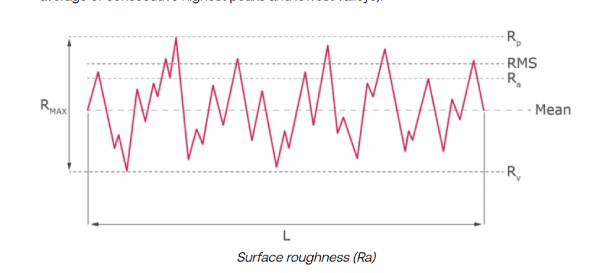
Surface roughness (Ra)
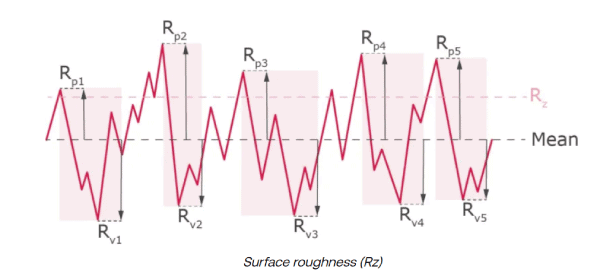
Surface roughness (Rz)
Surface roughness terminology
Ra – The numerical average of all the peaks and valleys across the length of the test. It’s also called the Center Line Average (CLA).
Rz – The average of consecutive highest peaks and lowest valleys. Vertical distance between the highest peak and lowest valley, the distance of the second highest peak and the second-lowest valley, etc. This is usually done for the five biggest deviations, and then an average is calculated.
Rp – The calculated distance between the profile’s tallest peak and the mean line within the evaluation length.
Rv – The calculated distance between the profile’s lowest valley and the mean line within the evaluation length.
Rmax – The biggest successive deviation between the highest peak and the lowest valley, calculated within the evaluation length.
RMS – Calculated within the evaluation length, this is the root mean square average of profile height variation from the mean line.