
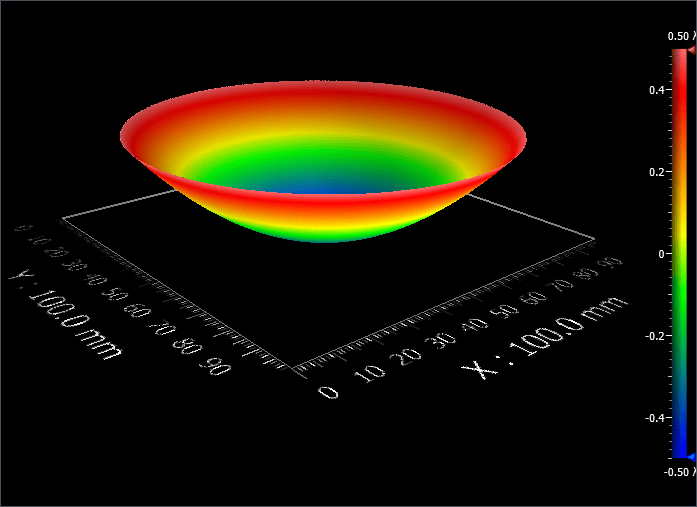
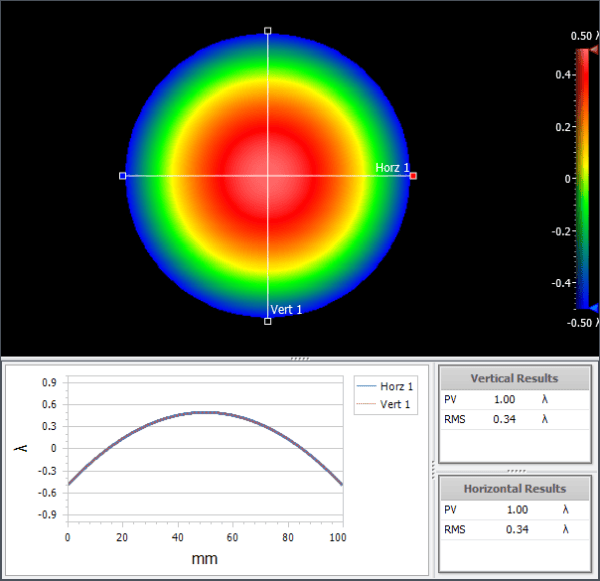
1 wave concave power
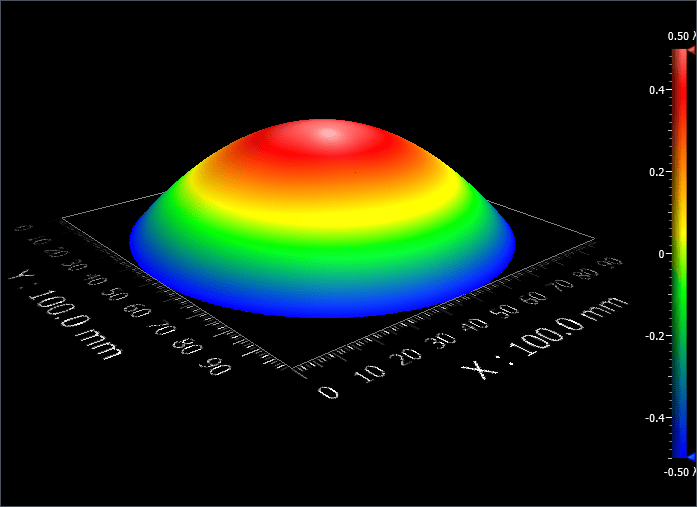
1 wave convex power
Surface Form testing is critical in any industry where light must be steered or focused with high precision. If the form, or large scale shape of an optic is off by a fraction of a wavelength, the performance of the entire optical system can fail. ISO standards separate surface form errors into three categories:
Power: Incorrect overall curvature, when a flat surface is slightly spherical (has ‘sag’) or a spherical surface has an incorrect radius of curvature. In both cases, it results in a system being out of focus, introducing blur into a projected image, or a slight ‘fog’ around a streetlamp as viewed by the driver.
Power error in spherical, cylindrical, and aspheric surfaces is the result of an incorrect radius of curvature. AMS measures radius of curvature directly and can convert the error from nominal radius (in millimeters) to an equivalent power error.
Irregularity: All remaining error after the power error is removed. This is the portion that can’t be corrected for by simply refocusing the optical system.
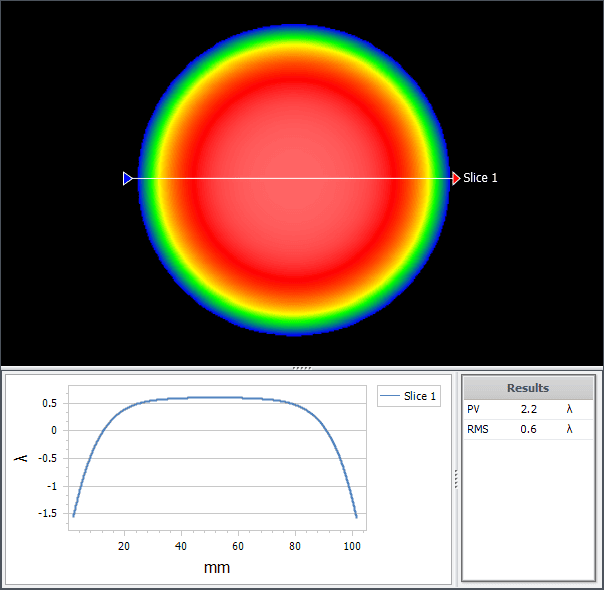
Edge roll, power included
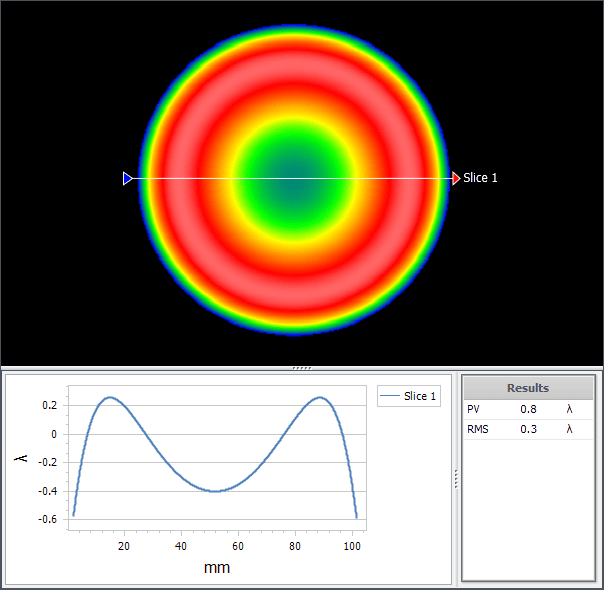
RSI component only (power removed)
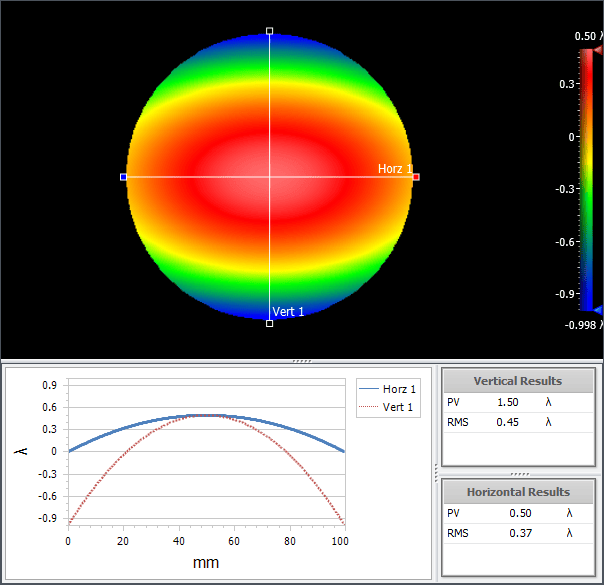
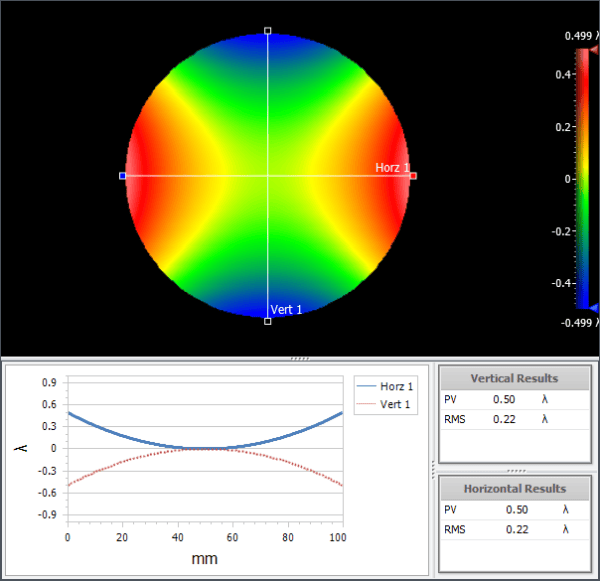
Irregularity includes astigmatism, which is a variation in curvature along different axes on a surface. This results in a ‘football’ or ‘potato chip’ shape and manifests itself as directional blur in an image. For someone with astigmatism errors in their eye, they might see the fog around a streetlamp slightly stretched in one direction. While trying to read a distant street sign, the vertical line of the letter ‘T’ might be more crisp than the horizontal line, or vice versa. Irregularity also includes ‘edge roll’, a rotationally symmetric function
Irregularity also includes the rotationally symmetric (RSI) component, specified separately. RSI errors are radially symmetric, having a consistent surface profile from center to edge regardless of orientation. A common RSI error is ‘edge roll’, where the surface falls off quickly at the edge. This can have a ‘soap bubble’ effect on images, where a bright star appears to have a sharp ring around it, or a streetlamp appears to have a brighter ring around its edge.
Why are we using all of these nighttime examples? Image distortion is more apparent at night because your pupils are dilated… a much larger section of your eye lens is being used!
Flatness is a specification that can be separated ino its power and irregularity components.
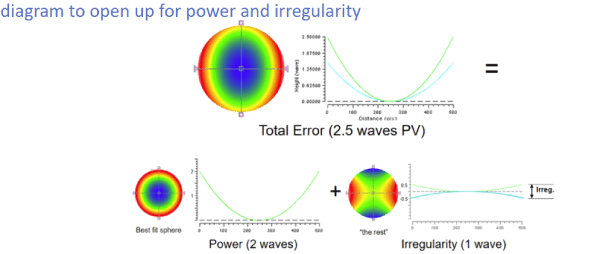
Total Surface Form Error = Power + Irregularity